
Availability
 Users, Editors, and Admins
 All organizations and accounts
 Exclusive to select subscription plans
MySQL is a widely used open-source relational database management system (RDBMS) that stores and retrieves structured data using SQL. It powers everything from small web applications to large-scale enterprise systems and is commonly deployed on-premises, in the cloud, or as a managed service such as Amazon RDS or Google Cloud SQL. Connecting MySQL to Databox lets you pull data directly from your database, build custom metrics using SQL queries, and visualize business-critical figures alongside data from your other connected tools.
If you've already established a connection, you can reuse it to add new data sources to your Databox account.
Databox only reads data from your database — it never writes to it. Create a dedicated MySQL user with SELECT-only privileges scoped to the Databox IP address.
MySQL 8.0+ (modern syntax):
CREATE USER 'databox'@'52.4.198.118' IDENTIFIED BY 'your_secure_password';
GRANT SELECT ON your_database.* TO 'databox'@'52.4.198.118';
FLUSH PRIVILEGES;
MySQL 5.x (legacy single-statement syntax):
GRANT SELECT ON your_database.* TO 'databox'@'52.4.198.118' IDENTIFIED BY 'your_secure_password';
FLUSH PRIVILEGES;
Replace your_database with the name of the database you want to connect, and your_secure_password with a strong password. If you need to grant access to multiple databases, repeat the GRANT statement for each one.

By default, MySQL binds only to localhost (127.0.0.1) and does not accept external connections. To allow Databox to connect, update the bind-address setting in your MySQL configuration file.
- Open your MySQL configuration file. The path depends on your system:
/etc/mysql/my.cnf/etc/mysql/mysql.conf.d/mysqld.cnf
- Locate the
bind-addressdirective in the[mysqld]section and set it to0.0.0.0(all interfaces) or your server's public IP:bind-address = 0.0.0.0 - Save the file and restart the MySQL service to apply the change:
sudo systemctl restart mysql
Open port 3306/TCP for inbound connections from the Databox IP address 52.4.198.118 on your server's firewall or network security rules. The exact steps depend on your infrastructure:
- Linux (iptables):
iptables -A INPUT -s 52.4.198.118/32 -p tcp --dport 3306 -j ACCEPT - AWS RDS: In the AWS Console, add an inbound rule to your database's security group allowing TCP on port 3306 from
52.4.198.118/32. - Other managed services: Add
52.4.198.118to your database's IP allowlist in the service's network access settings.
- In Databox, go to Data manager > Data sources > + Add data source
- Search for MySQL and click Connect.
- Fill in the connection form:
- Data source name — a label for this connection in Databox.
- Host — the hostname or IP address of your MySQL server.
- Port — the port MySQL listens on. The default is
3306. - User — the MySQL username created in Step 1.
- Password — the password for that user.
- Database name (optional) — the specific database to connect to. Leave blank to connect at the server level.
- Timezone — the time zone used to interpret date values in query results. Defaults to
Etc/UTC.
- Select an SSL/TLS mode (see SSL/TLS below).
- Click Connect.
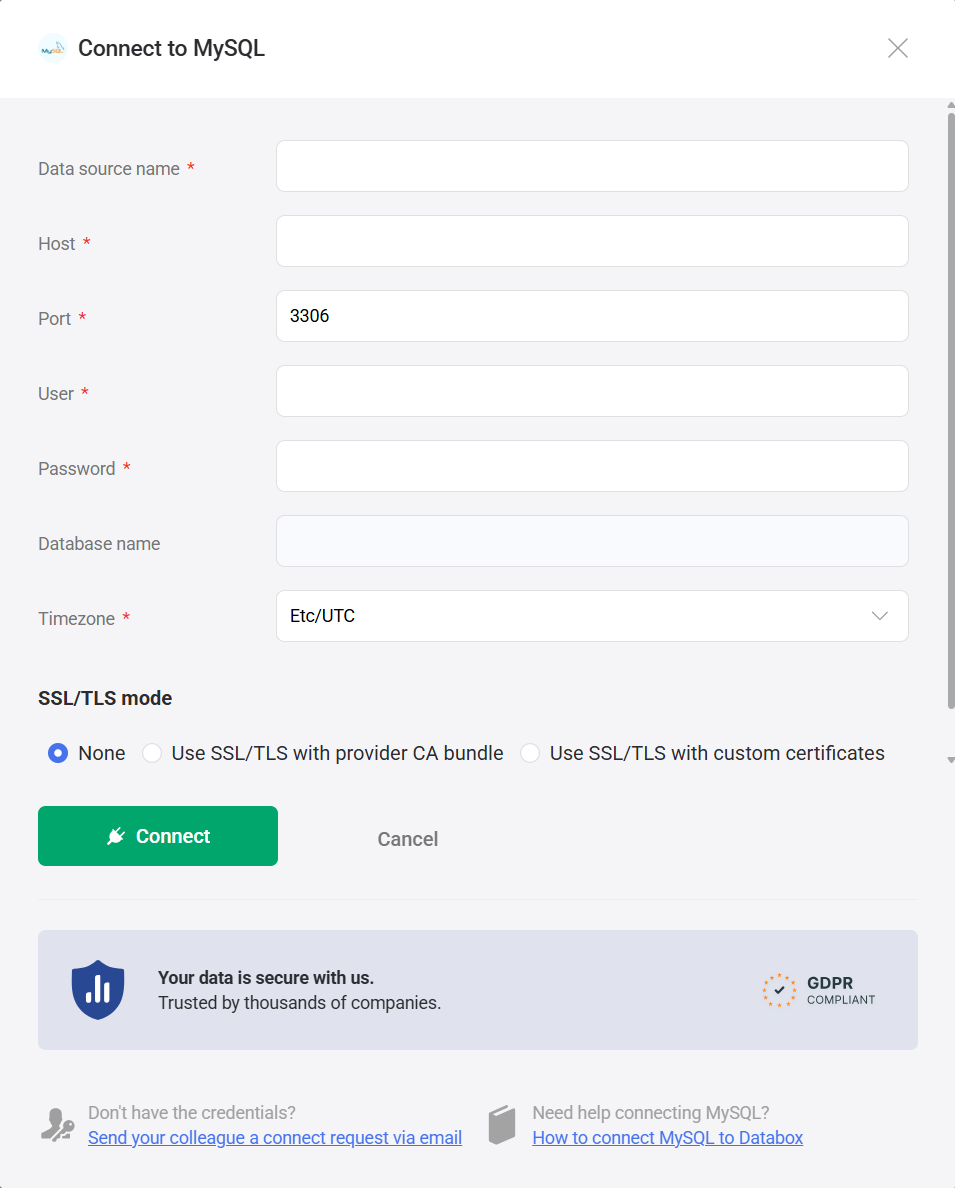
Databox offers three SSL/TLS modes when connecting to a database. Choose the one that matches your server's configuration.
| Mode | Description |
|---|---|
| None | The connection is made without SSL/TLS encryption. Use this only when your server does not have SSL enabled. |
| Use SSL/TLS with provider CA bundle | The connection uses SSL/TLS and authenticates the server using a regional CA bundle managed by your cloud provider (for example, Amazon RDS). When you check Verify server certificate using regional CA bundle, an additional CA certificate bundle (ssl-ca) field appears, where you can paste your provider's CA certificate. |
| Use SSL/TLS with custom certificates | The connection uses SSL/TLS with certificates you supply directly. When Verify server certificate is checked, you must provide a CA certificate (ssl-ca). You may also supply a Client certificate (ssl-cert) and Client private key (ssl-key) for mutual TLS. If Verify server certificate is unchecked, only the client certificate and private key fields are shown. |
For step-by-step instructions on generating or obtaining SSL certificates and configuring them for each mode, see Enable SSL/TLS for your database connection.
The MySQL integration supports the creation of datasets, which allow you to define and shape the specific data you want to use for reporting in Databox. Datasets make it easier to focus on the most relevant information, enabling you to filter, visualize, and analyze metrics across projects, teams, and clients without writing complex queries each time.
- Select a table: Pick the appropriate schema within that database.
- Select columns: Browse and select the specific columns (fields) from your tables or views to include in your dataset. These columns define the structure and content of your dataset.
For more advanced use cases, you can write a custom SQL query instead of selecting columns manually. This allows you to:
- Join multiple tables
- Apply filters and aggregations
- Format or transform data before importing it into Databox
Your query must return a valid tabular result to be used as a dataset.
- MySQL Documentation — Official MySQL documentation hub covering installation, SQL syntax, storage engines, security, replication, and release notes for all supported versions.
- MySQL 8.0 Reference Manual — Complete reference for MySQL 8.0, including SQL statements, data types, functions, user management, and server configuration.
For comprehensive details on metrics, data availability, templates, specifications, usage guidelines, and other key information, refer to the resources listed below.


FAQ
Can I connect a managed MySQL service like Amazon RDS or Google Cloud SQL?
Yes. Managed MySQL services are supported. Make sure the database is publicly accessible and that the Databox IP address (52.4.198.118) is added to the service's inbound security rules or IP allowlist. For Amazon RDS, refer to the AWS documentation for configuring SSL and network access.
What should I do if Databox cannot connect to my MySQL server?
Check the following in order:
- The
bind-addressin your MySQL configuration allows external connections - Your firewall permits inbound TCP traffic on port
3306from52.4.198.118 - The MySQL user was created with
'databox'@'52.4.198.118'as the host — not'%'or'localhost'. RunFLUSH PRIVILEGES;after any user or grant changes.


