
Availability
 Users, Editors, and Admins
 All organizations and accounts
 Exclusive to select subscription plans
Amazon Aurora is a cloud-native relational database engine from AWS that is fully compatible with PostgreSQL while delivering up to three times the throughput of standard PostgreSQL on the same hardware. Aurora clusters automatically replicate data across multiple Availability Zones, handle failover, and manage storage scaling without manual intervention. Connecting Amazon Aurora for PostgreSQL to Databox lets you pull data directly from your Aurora cluster, build datasets using SQL queries, and visualize business-critical figures alongside data from your other connected tools.

If you've already established a connection, you can reuse it to add new data sources to your Databox account.
Databox only reads data from your database — it never writes to it. Create a dedicated PostgreSQL role with SELECT-only privileges on the schemas and tables you want to expose. You can run these commands using a PostgreSQL client connected to your Aurora cluster endpoint, or via the Query Editor in the AWS Management Console.
CREATE ROLE databox WITH LOGIN PASSWORD 'your_secure_password';
GRANT CONNECT ON DATABASE your_database TO databox;
GRANT USAGE ON SCHEMA public TO databox;
GRANT SELECT ON ALL TABLES IN SCHEMA public TO databox;
ALTER DEFAULT PRIVILEGES IN SCHEMA public GRANT SELECT ON TABLES TO databox;
Replace your_database with the name of the database you want to connect, and your_secure_password with a strong password. If you need to expose tables in additional schemas, repeat the GRANT USAGE and GRANT SELECT statements for each schema.
By default, Aurora instances are not accessible from outside their VPC. To allow Databox to reach your cluster, each instance in the cluster must be configured as publicly accessible.
- In the AWS Management Console, go to Databases and select your Aurora DB cluster.
- Select an individual DB instance within the cluster (not the cluster itself).
- Click Modify.
- Under Connectivity, set Public access to Yes.
- Click Continue, then choose Apply immediately.
- Click Modify DB instance to save.
- Repeat for any other instances in the cluster.
Aurora controls network access through VPC security groups. Add an inbound rule that permits TCP traffic on port 5432 from the Databox IP address.
- In the AWS Management Console, go to Databases and select your Aurora DB cluster.
- Under Connectivity & security, click the link to the VPC security group associated with the cluster.
- Select the security group, then click Edit inbound rules.
- Click Add rule and fill in:
- Type: PostgreSQL
- Protocol: TCP
- Port range: 5432
- Source: Custom — enter
52.4.198.118/32
- Click Save rules.
- In Databox, go to Data manager > Data sources > + Add data source
- Search for PostgreSQL and click Connect.
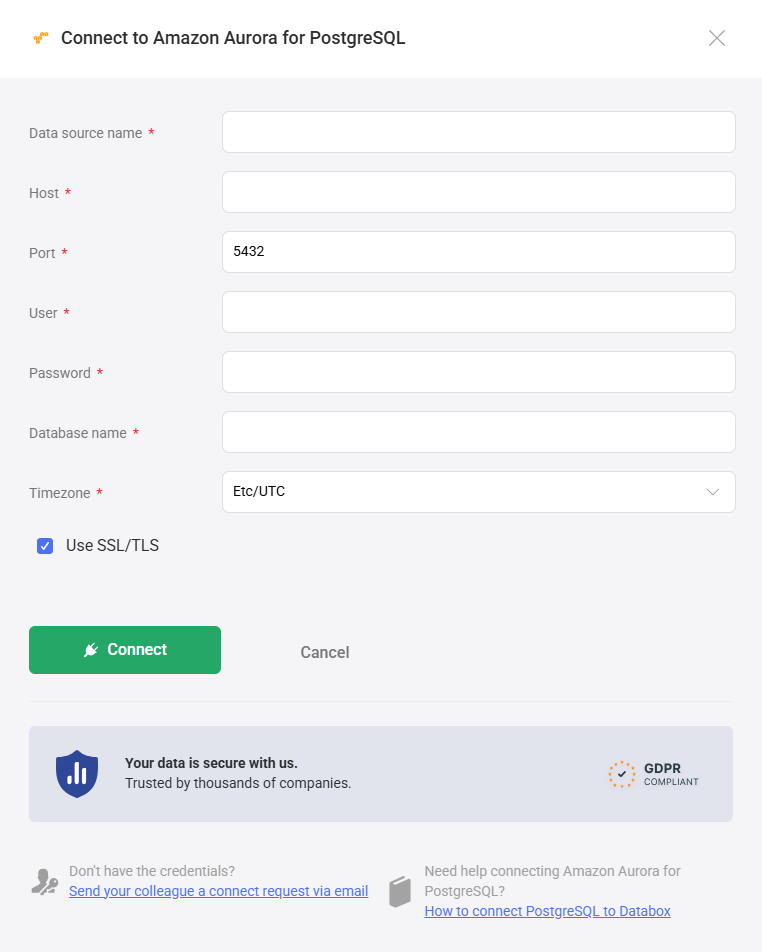
- Fill in the connection form:
- Data source name — a label for this connection in Databox.
- Host — your Aurora cluster endpoint, found on the cluster's Connectivity & security tab in the AWS Console (e.g.,
my-cluster.cluster-abc123.us-east-1.rds.amazonaws.com). You can also use the reader endpoint (my-cluster.cluster-ro-abc123.us-east-1.rds.amazonaws.com) to route queries to read replicas only. - Port — the port your Aurora cluster listens on. The default for PostgreSQL-compatible Aurora is
5432. - User — the PostgreSQL role name created in Step 1.
- Password — the password for that role.
- Database name (optional) — the specific database to connect to. Leave blank to connect at the server level.
- Timezone — the time zone used to interpret date values in query results. Defaults to
Etc/UTC.
- Toggle Use SSL/TLS to enable encrypted connections.
- Click Connect.
The Amazon Aurora for PostgreSQL integration supports the creation of datasets, which allow you to define and shape the specific data you want to use for reporting in Databox. Datasets make it easier to focus on the most relevant information, enabling you to filter, visualize, and analyze metrics across projects, teams, and clients without writing complex queries each time.
- Select a table: Pick the appropriate schema within that database.
- Select columns: Browse and select the specific columns (fields) from your tables or views to include in your dataset. These columns define the structure and content of your dataset.
For more advanced use cases, you can write a custom SQL query instead of selecting columns manually. This allows you to:
- Join multiple tables
- Apply filters and aggregations
- Format or transform data before importing it into Databox
Your query must return a valid tabular result to be used as a dataset.
- Amazon Aurora documentation — Official AWS docs for Amazon Aurora, covering cluster creation, connectivity, security, backups, global databases, and monitoring.
- Amazon Aurora PostgreSQL-compatible edition — PostgreSQL-specific guidance within the Aurora User Guide, including supported versions, parameter groups, and engine-specific features.
For comprehensive details on metrics, data availability, templates, specifications, usage guidelines, and other key information, refer to the resources listed below.


FAQ
Can I connect to the Aurora reader endpoint instead of the cluster endpoint?
Yes. Databox accepts either the cluster endpoint or the reader endpoint. The reader endpoint (my-cluster.cluster-ro-abc123.us-east-1.rds.amazonaws.com) distributes read queries across Aurora Replicas and is a good choice for Databox since it only issues SELECT queries. Use the cluster endpoint if your cluster has no replicas.
Does Databox support Aurora Serverless?
Aurora Serverless v2 uses standard PostgreSQL connectivity and is supported — set it up the same way as a provisioned cluster. Aurora Serverless v1 uses the RDS Data API for connections and does not expose a standard TCP endpoint, so it is not compatible with the Databox connector.
What should I do if Databox cannot connect to my Aurora cluster?
Check the following in order:
- Public access is set to Yes on the DB instances within the cluster (under Modify > Connectivity).
- The VPC security group has an inbound rule allowing TCP on port
5432from52.4.198.118/32. - The subnet group includes subnets with a route to an internet gateway (
0.0.0.0/0). - The PostgreSQL role was created with
LOGINprivileges and the correct password. Verify with\duin apsqlsession connected to the cluster.


