


Setting the correct time zone for your data source ensures that the date ranges you select in the app accurately match the data stored in the system. For example, if your marketing platform reports data in Eastern Time but your account is set to Pacific Time, setting the correct time zone eliminates discrepancies and prevents your visualizations from showing empty or misleading data.
You can change the time zone of a data source from either of the following locations:
To change the time zone:
- Find the data source and click the down caret next to it.
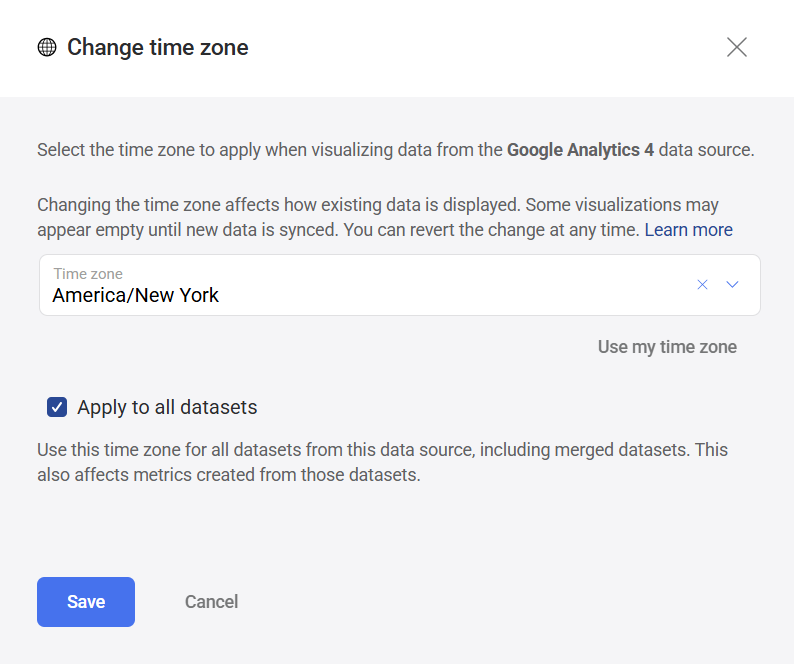
- Select Change time zone.
- Choose a time zone from the dropdown list, or click Use my time zone to apply your profile time zone.
- Select Apply to all datasets to apply this time zone to all datasets from this data source.
- Click Save to apply the changes.

When you add a new data source, Databox tries to detect its time zone by extracting information from the integration's API. If the integration provides this data, it's saved and used as the data source's time zone within Databox.
If no time zone info is available from the integration, Databox defaults to the profile time zone of the user who connected the data source.
All synced data is stored locally in UTC, along with the original time zone offset when available. Storing timestamps in UTC ensures consistency across all data sources.
However, because of this, time-based filters and visualizations rely on the data source time zone setting to translate UTC timestamps into the correct local time when querying and displaying your data.
Thedata source time zone setting defines how Databox interprets the start and end of selected date ranges for that data source.
For example, if your report shows data for "Today" and the data source time zone is set to Pacific Time, Databox will query data from midnight to midnight Pacific Time — even though the underlying data is stored in UTC.
This ensures that filters and visualizations match the local time context of the data source.
Changing the data source time zone affects how previously synced data is queried and displayed.
Since the stored timestamps are aligned with the original time zone, switching to a different time zone can cause:
- Empty or missing visualizations
- Apparent loss of historical data
- Date shifts or mismatches
This happens because the system interprets date ranges differently after the change, leading to mismatched queries.
If this occurs, reverting the data source time zone back to its original setting will restore the previously visible historical data.
When validating synced data, it's important to consider several time zones:
- Your local device's time zone — may affect how dashboards appear across tools
- Your account's time zone in the external app (e.g., Google Ads, HubSpot)
- The time zone used by the external app's reporting interface — might be fixed or adapt to your device
- The time zone the external API returns data in — varies by provider
- UTC storage in Databox — all data is stored in Coordinated Universal Time for consistency
- The data source time zone setting in Databox — used to interpret date ranges when filtering and visualizing
Ideally, these time zones align or are at least understood clearly when comparing data. Misalignments can cause confusion — such as seeing different values for the same metric depending on where or when you view the data.
FAQ
Does Databox handle Daylight Saving Time (DST)?
Yes, Databox automatically adjusts for Daylight Saving Time in time zones that observe DST, ensuring your data reflects the correct local time throughout the year.
When should I change the data source time zone?
It's best to set the data source time zone immediately after adding your data source and before any data sync occurs. Changing it later can lead to issues such as missing or mismatched data, as described above.
Who can set the data source time zone?
Admins can set the data source time zone for all applicable data sources. Users with User or Editor roles can only set the time zone for data sources they added.


